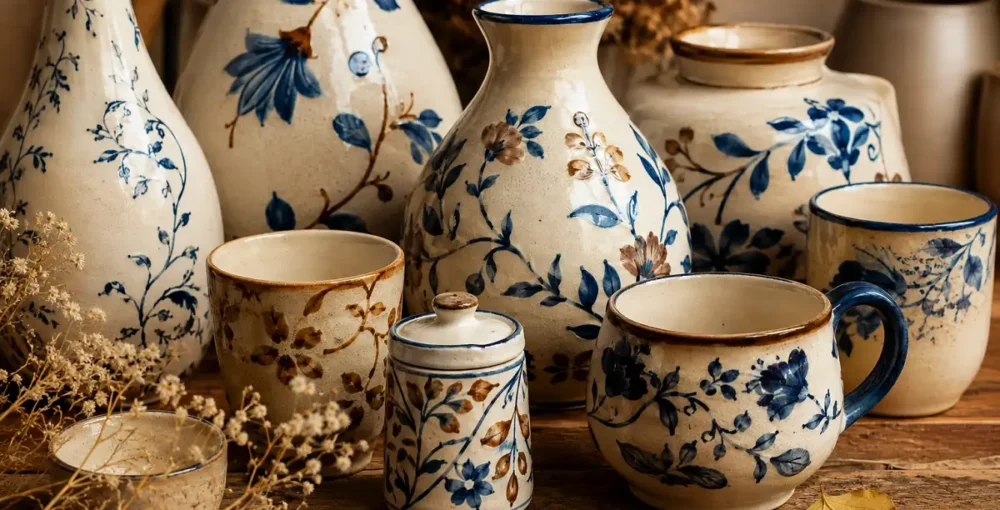
Genuine Khurja pottery shows small natural variations, hand-painted detail, a warm off-white ground, and honest provenance from a Khurja seller. Factory imitations look machine-identical, with flawless repeated patterns and no real maker behind them. No single visual test is foolproof, so the surest check is provenance: buy from someone who sources directly from Khurja artisans.
Shop Khurja Pottery · Chat on WhatsApp
What makes authentic Khurja pottery distinctive?
Authentic Khurja pottery has a look you can learn to read. It is usually hand-painted with floral and vine motifs in blue or brown, set against a warm off-white or cream ground. The body is not plain clay: it is a mix of clay with feldspar and quartz, which gives the ware its glassy glaze and solid, durable feel.
Because each piece is shaped and finished by hand, small differences are part of the craft, not flaws. If you want the full background on where this tradition comes from, see our guide to the history of Khurja pottery.
Six signs of genuine handmade Khurja pottery
Run through these six checks. No single one is proof on its own, but together they tell you a lot:
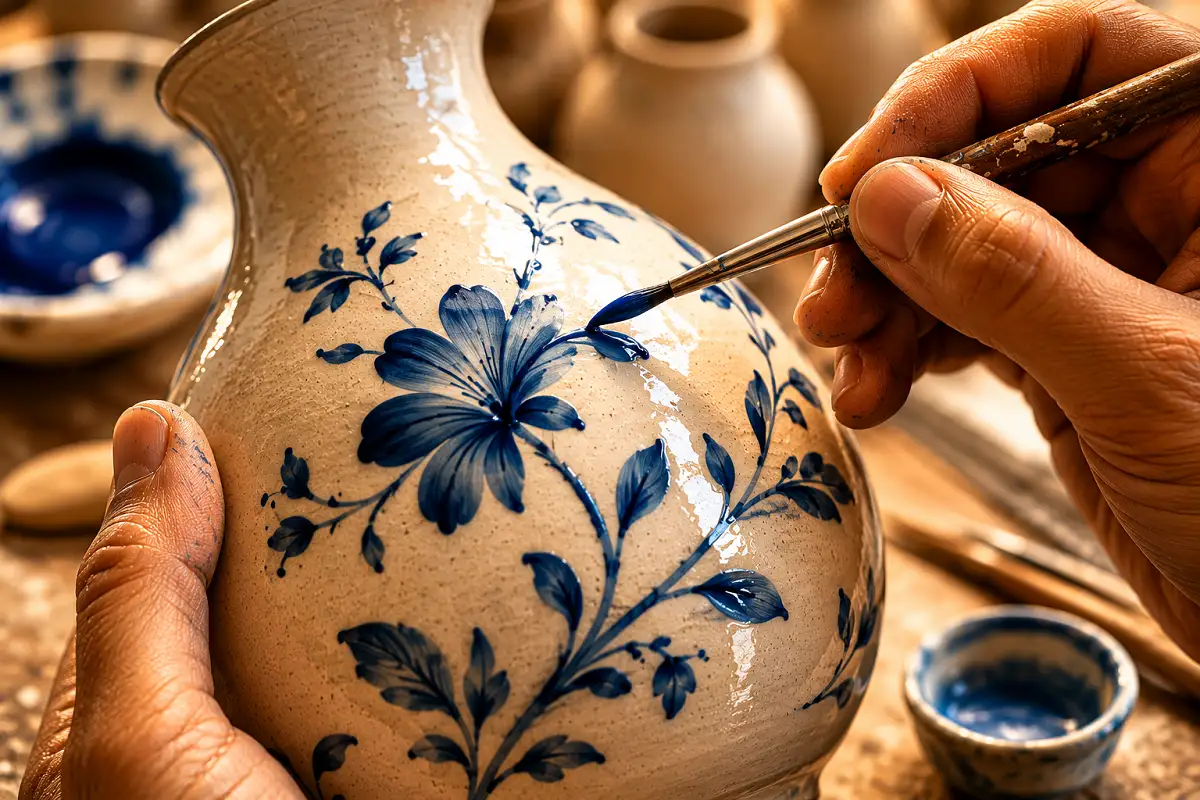
- Hand-painted, not printed. Look closely at the motifs. Real hand-painting has slight wobble in the lines, brush strokes you can feel, and tiny asymmetries. A printed or transfer pattern looks flat and perfectly even, often with a faint dot texture.
- Natural variation between pieces. Put two of the same design side by side. Genuine pieces differ a little in colour depth, motif placement, and size. A factory set looks like identical clones.
- A warm off-white ground. Traditional Khurja ware sits on a soft cream or off-white base, not a stark, bright, plastic-looking white. Modern pieces do use more colours now, so treat this as a clue, not a rule.
- Honest glaze character. A real glaze is glassy and may show gentle unevenness, slight pooling in the recesses, or fine surface lines. Flawless, mirror-uniform coating across a whole batch points to mass production.
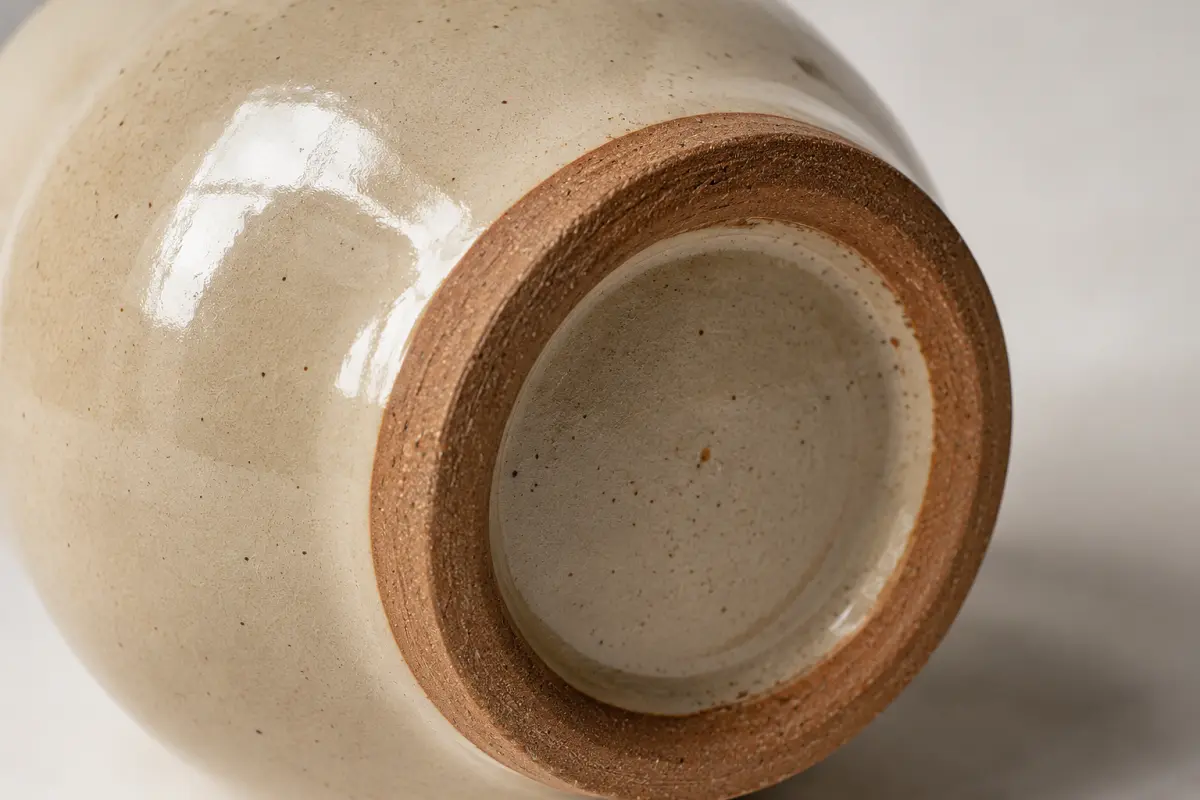
- Weight and an unglazed foot. Khurja stoneware feels substantial in the hand. Turn it over: the foot or base ring is usually left unglazed, showing the fired clay body. Very light, hollow-feeling ware is a warning sign.
- A maker behind it. Genuine pieces come with a story and a source. The seller can tell you it was made in Khurja, and often by which kind of workshop.
Authentic vs imitation: a quick comparison
Here is the difference at a glance:
| What to check | Authentic handmade Khurja | Factory imitation |
|---|---|---|
| Two pieces of the same design | Slightly different, never identical | Identical clones |
| Decoration | Hand-painted, small irregularities | Printed or transfer, flat and even |
| Glaze | Glassy with gentle unevenness | Mirror-uniform across the batch |
| Ground colour | Warm off-white or cream | Stark, bright, uniform white |
| Base / foot | Unglazed foot ring, fired clay visible | Fully coated, sometimes very light |
| Provenance | Traceable to Khurja artisans | Vague or unknown origin |
Does authentic Khurja pottery have a GI label to look for?
This is where many buyers get misled. Khurja pottery, as a craft, holds a Geographical Indication (GI) tag granted in 2008. That recognises the tradition of the town and region. It is not a sticker or certificate printed on each individual pot.
So if a seller waves a “GI certificate” for one specific product as proof it is special, treat that as a red flag rather than reassurance. The GI is about the craft of Khurja, not a per-item guarantee.
The simplest way to be sure: provenance
Every visual sign above can be faked by a skilled factory, and some Khurja workshops themselves now use moulds and transfers for parts of the process. That is the honest reality. So the one check that actually settles it is provenance: buy from a seller who sources directly from Khurja artisans and can tell you plainly where a piece was made.
That is exactly how we work. Our ceramic planters and pots and our kitchenware and dinnerware come direct from Khurja, with no mystery about their origin. You can read more on About Khurja Pottery Hub, or just message us and ask about any piece.
Shop Khurja Pottery · Chat on WhatsApp
Frequently asked questions
Is colour or size variation in Khurja pottery a defect?
No. Small differences in colour depth, motif placement, and size are normal in handmade pottery and are actually a sign of authenticity. Each piece is shaped, painted, and fired by hand, so no two come out identical. Perfectly matching pieces are more likely to be machine-made.
Can a factory copy the look of Khurja pottery?
Yes. A skilled factory can imitate the off-white ground and floral motifs, and even some Khurja workshops use moulds and transfers. That is why no single visual test is foolproof. The look gives you strong clues, but provenance, knowing the piece came from Khurja artisans, is what truly settles it.
Is Khurja pottery the same as Jaipur blue pottery?
No, they are different crafts. Khurja pottery is clay-based glazed stoneware, fired hotter, and built for everyday use. Jaipur blue pottery uses a no-clay frit body of quartz and powdered glass, is low-fired, and is more fragile and mostly decorative. Both are Indian, but the materials and uses differ.
Does authentic Khurja pottery always have blue floral designs?
Traditionally it does, with blue or brown florals on a cream ground. But modern Khurja has expanded into many colours, shapes, and plain glazes. So design style alone does not prove authenticity. Use it as one clue alongside hand-painting, glaze, weight, and provenance.
Is Khurja pottery food safe and lead free?
Our tableware is made to be food-safe and lead-free, using glazes intended for everyday eating and drinking. As a general rule, for any glazed tableware, it is worth confirming the glaze is food-safe before serving on it. Message us and we will tell you about any specific piece.
Why is the base of a Khurja pot left unglazed?
The foot or base ring is usually left bare so the piece does not stick to the kiln shelf during firing. It also lets you see the fired clay body underneath the glaze. A clean, unglazed foot showing real ceramic is a useful sign of genuine glazed stoneware.
Does Khurja pottery come with a GI certificate?
No. Khurja pottery holds a Geographical Indication tag as a craft of the region, granted in 2008, but there is no per-item GI certificate stamped on individual pots. Be cautious of any seller who claims a GI stamp on a single product as proof of value.
How can I be completely sure a piece is authentic Khurja?
The only reliable way is provenance. Buy from a seller who sources directly from Khurja artisans and can tell you where the piece was made. Visual signs help, but origin is decisive. We source all our pottery direct from Khurja, so you always know what you are buying.