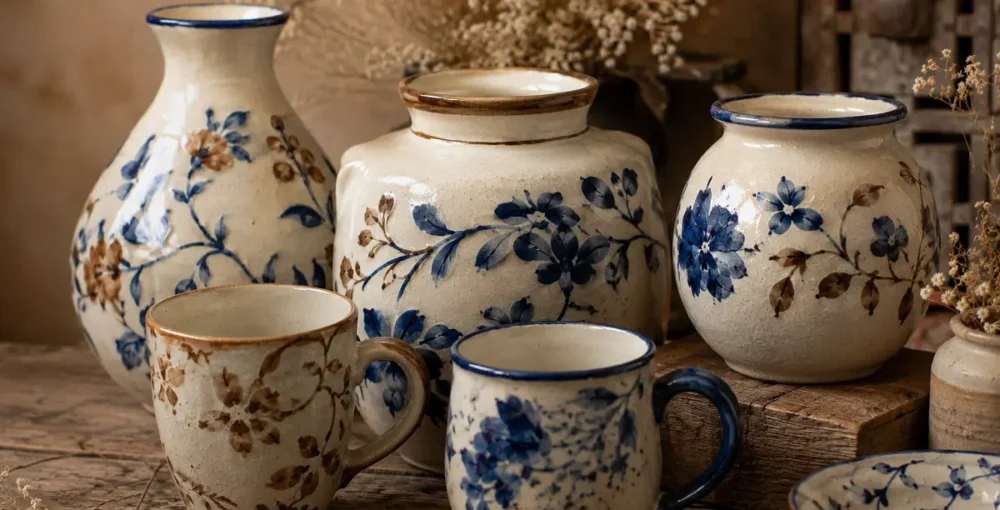
Khurja pottery is a traditional glazed ceramic craft from Khurja, a town in the Bulandshahr district of Uttar Pradesh, India, known as the Ceramic City. Its history stretches back more than 600 years, to migrant potters who settled near Delhi and blended Persian and Central Asian techniques with Indian design. Today the craft holds a Geographical Indication tag and supplies ceramics across India and the world.
Shop Khurja Pottery · Chat on WhatsApp
What is Khurja pottery?
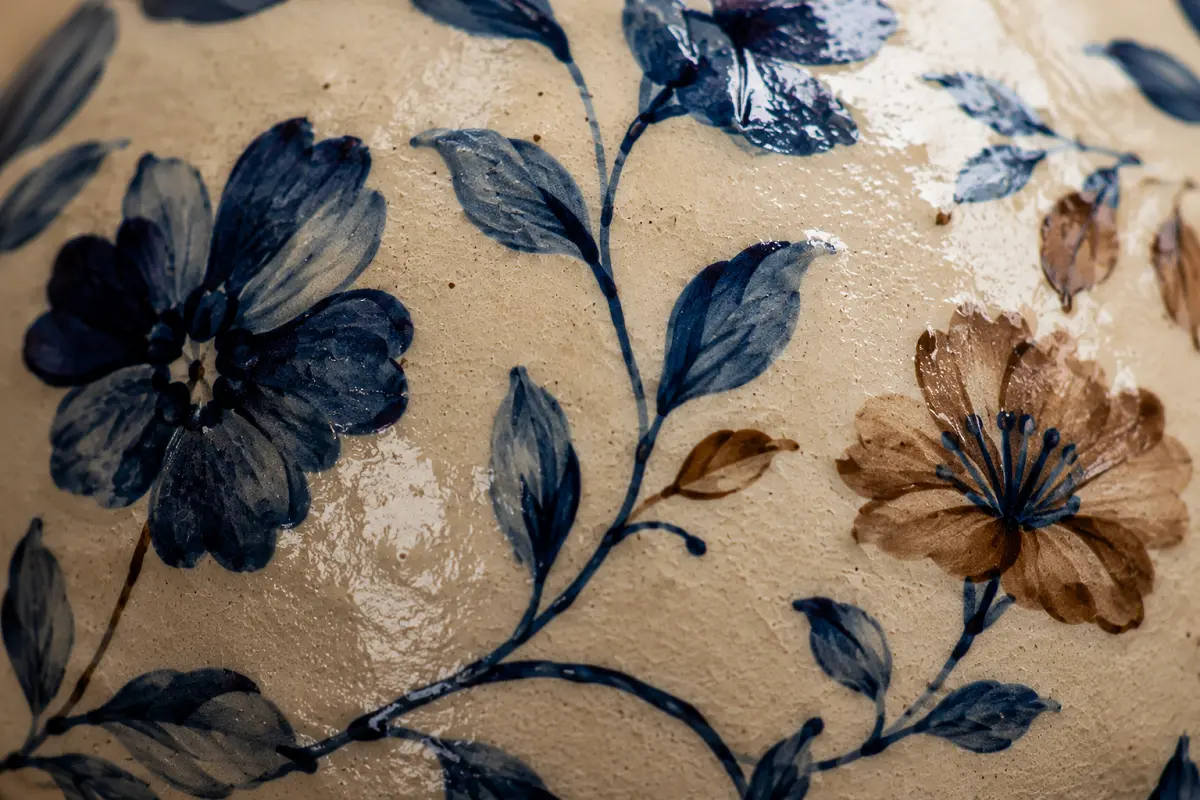
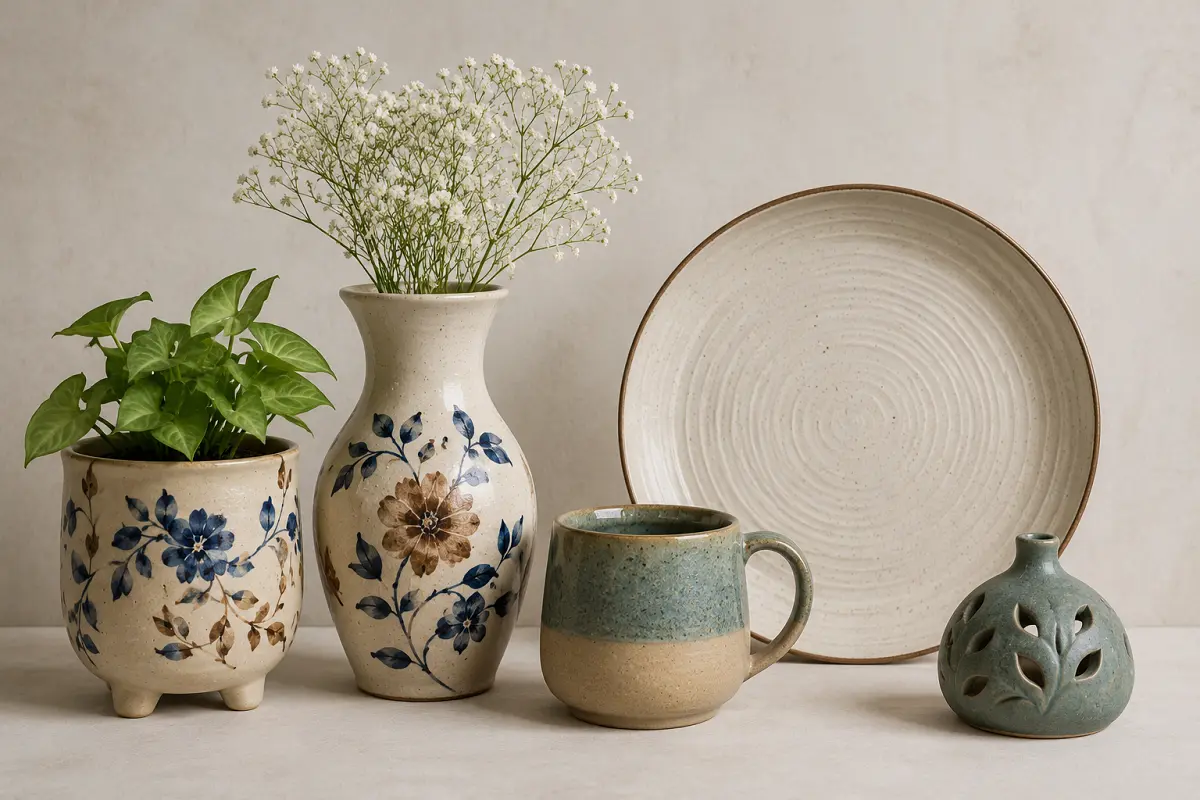
Khurja pottery is a distinctive style of glazed ceramic, recognised by its hand-painted floral and vine motifs, usually in blue or brown on a warm off-white ground. What sets it apart is the body itself. It is not made from plain clay alone, but from clay mixed with feldspar and quartz, which gives the ware its natural glaze and durability.
The craft covers a wide range of pieces, from ceramic planters and pots to kitchenware and dinnerware, along with decorative ware, vases, and tiles. The scholar Baidyanath Saraswati, in Pottery-Making Cultures and Indian Civilization, describes Khurja as one of the oldest centres of glazed pottery in India.
How old is Khurja pottery?
Khurja pottery is more than 600 years old. Most accounts place the craft’s arrival between the 14th and 15th centuries, though the exact timeline is debated, and estimates across different sources range from roughly 500 to 700 years.
What is not in doubt is that Khurja is one of the oldest continuous centres of glazed pottery in South Asia. The craft has been handed down through generations of potter families, many of whom still work in the town today.
Where did Khurja pottery come from? The competing legends
“Khurja is known across the globe for its sheer poetry in clay.” S M Khan, Khurja pottery expert and historian, cited in Deccan Herald.
The origins of Khurja pottery are wrapped in several competing accounts, and the honest answer is that no single one is settled history. Here are the main legends, as told by different sources:
- The Timur legend. One widely repeated story holds that potters from Egypt and Syria travelled with the Central Asian conqueror Timur (Tamerlane) during his invasion of northwest India over 600 years ago, and brought advanced glazing techniques with them.
- The Mughal and Tughlaq account. Another traces the craft to the medieval Muslim courts, linking it to the rule of Muhammad bin Tughlaq in the mid-14th century, with later Mughal patronage helping it grow.
- The Kheshgi founding. Some histories credit the founding of the town itself to the Kheshgi family, a Pashtun ruling family that settled in the region during this period.
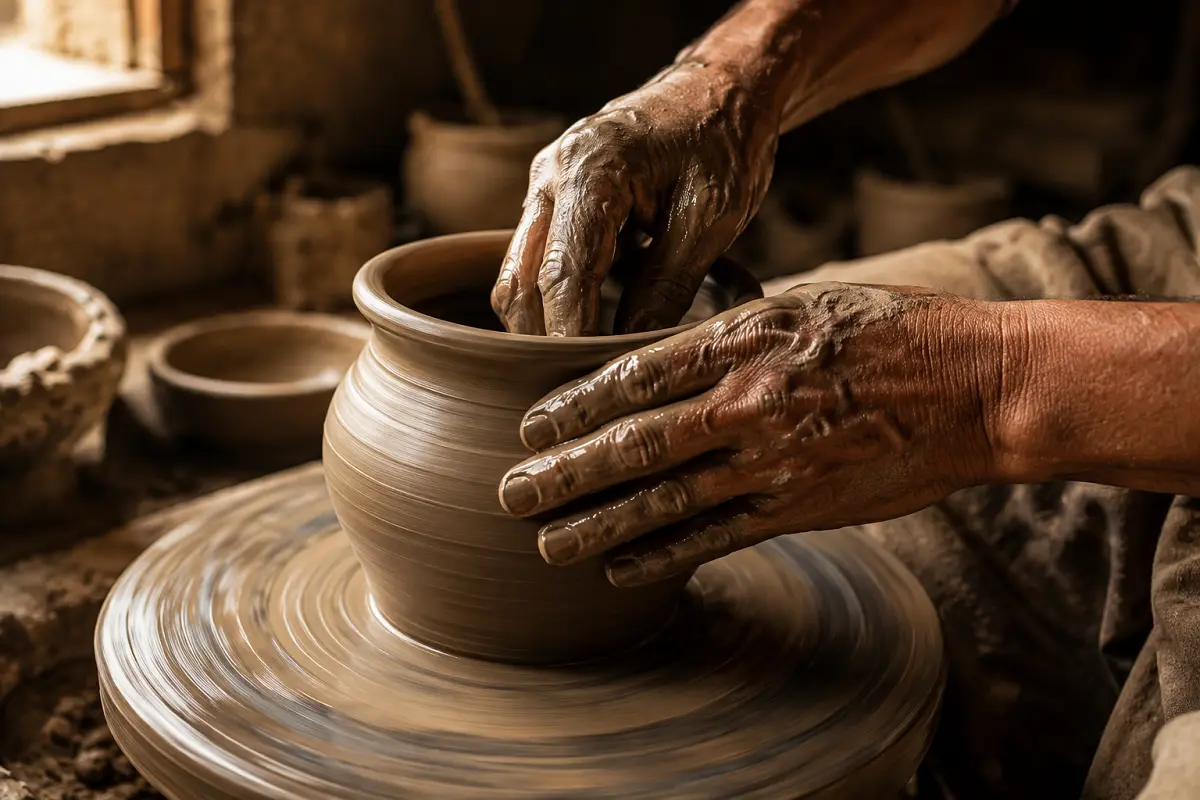
- The Multani Kumhar lineage. Many Khurja potters call themselves Multani Kumhars, pointing to Multan, in present-day Pakistan, as the home their ancestors migrated from.
Why is Khurja called the Ceramic City?
Khurja sits about 85 kilometres from Delhi and is one of the larger towns in the National Capital Region. Its name is said to come from the Urdu word “kharija,” meaning cancelled, a reference to the town’s early history of swampy land and waived revenue.
Geography helped the craft take root. Khurja lies in the fertile Ganges-Yamuna belt, with clay-rich soil, while potters bring in quartz and feldspar from Rajasthan and Gujarat for their distinctive natural glaze. Over time, so much of the local economy came to revolve around pottery and ceramics that the town earned its lasting nickname: the Ceramic City of India. Most families here either run a pottery unit or work in one.
How Khurja grew into a ceramic powerhouse
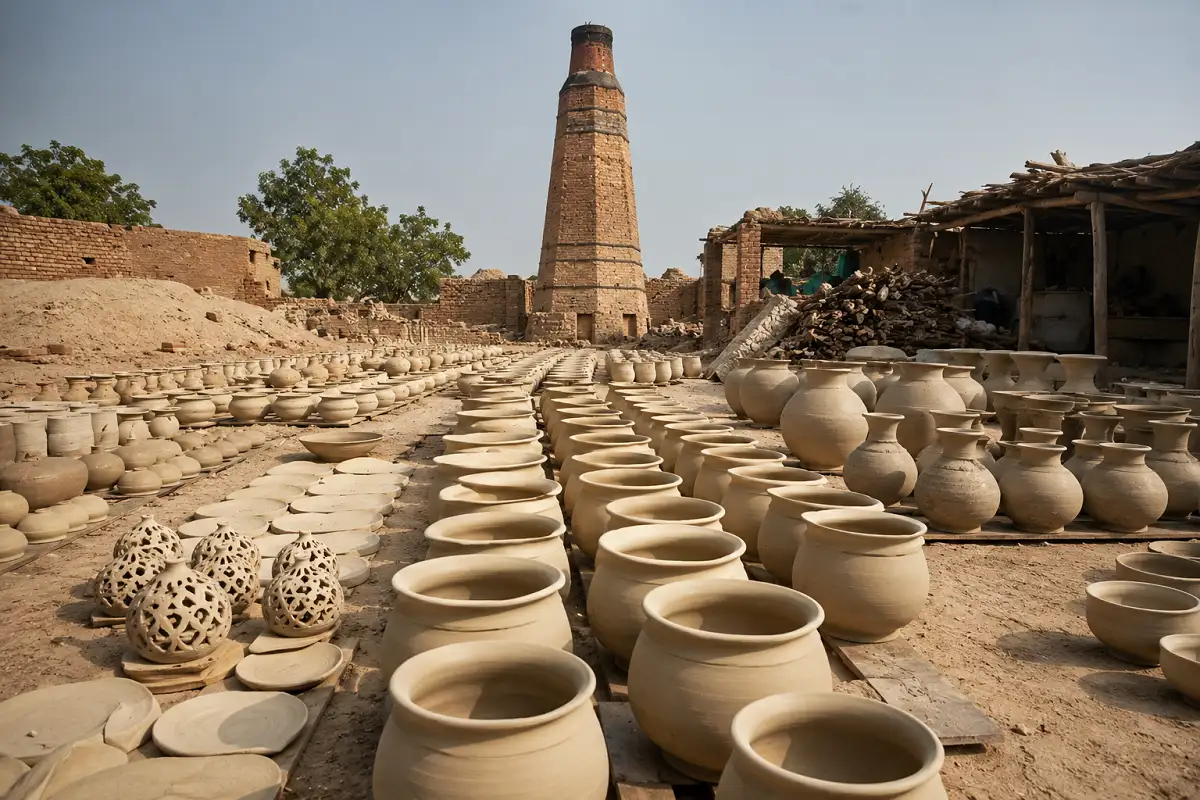
Khurja’s rise from a regional craft town to a national ceramic hub happened in clear stages:
| Period | What happened |
|---|---|
| 14th to 15th century | Migrant potters settle in Khurja. Competing legends credit Timur’s Egyptian and Syrian artisans, Mughal and Tughlaq-era patronage, and Multani Kumhar families. |
| Mughal era | Potters become known for fine floral and geometric underglaze designs. |
| 1860s | The Delhi to Kolkata railway reaches Khurja, turning a regional craft into a national supplier, served by Khurja Junction and Khurja City stations. |
| 1942 | The United Provinces government opens a pottery factory, later closed in 1946 to 1947. |
| 1952 | The factory is revived as the Pottery Development Centre. |
| Late 1950s to 1960s | A design centre opens, German technical expertise is brought in, and a high-tension laboratory is set up to test insulators. |
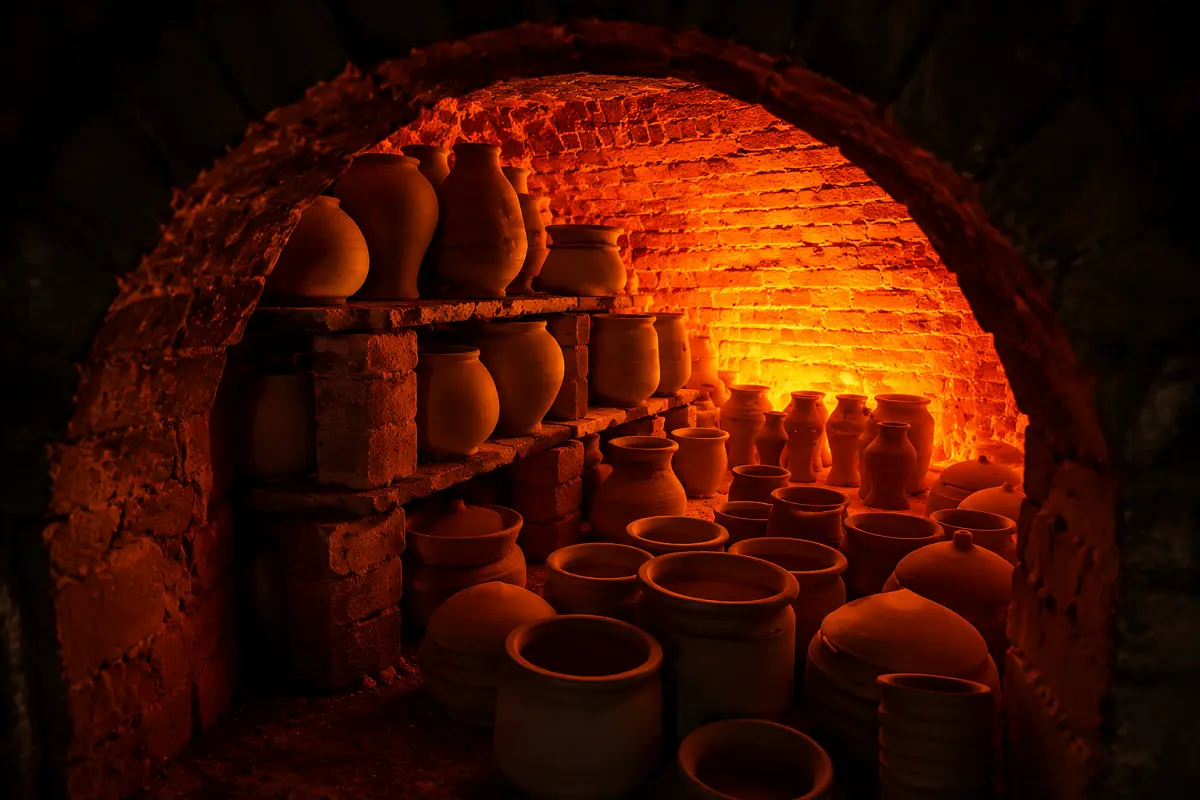
| 1990s | Polluting coal-fired kilns are phased out, and more efficient shuttle kilns arrive in 1993 to 1994. |
| 2008 | Khurja Pottery receives its Geographical Indication (GI) tag. |
| Today | Modern gas-fired kilns, One District One Product (ODOP) support, and the planned Ceramic Haat under the Khurja Master Plan 2031. |
A popular local story also credits the Second World War with raising the town’s profile. As it is told, a British wartime order for ceramic ware was filled so well that it drew fresh attention to Khurja’s potential as a ceramic hub. It is a widely repeated tale rather than firmly documented history, but it captures how the town’s reputation grew.
What does Khurja make today?
Modern Khurja produces far more than decorative pottery. Its workshops and factories make tableware and crockery, planters, vases, tiles, sanitaryware, scientific and chemical porcelain, and electrical insulators, alongside the hand-painted decorative ceramics the town is loved for.
The cluster is one of the largest of its kind in India. Across roughly 500 units and around 400 factories, sources estimate that between 15,000 and 25,000 people work in the trade, with several thousand more in supporting roles. Khurja ceramics are exported to countries including the United Kingdom, the United States, Australia, New Zealand, the United Arab Emirates, and Germany.
The craft has also modernised. Many units have moved from polluting coal-fired kilns to cleaner, more energy-efficient natural gas furnaces, which fire more evenly and produce better, more consistent ware.
Khurja pottery and its Geographical Indication (GI) tag
In 2008, Khurja Pottery was granted a Geographical Indication (GI) tag, registered under India’s GI Act and the international TRIPS agreement. A GI tag recognises a craft that is tied to a specific place and produced using traditional, regional methods.
It is important to understand what this means. The GI recognises Khurja pottery as a craft of the town and region. It is a mark of the craft’s heritage and authenticity as a tradition, not a certificate stamped on any one seller’s individual products.
Why Khurja pottery still matters
Khurja pottery is a living craft, not a museum piece. The same families that shaped clay generations ago still supply Indian homes, restaurants, and export buyers today. Ceramic kalash, festive diyas, everyday tableware, and decorative pieces all keep the tradition woven into daily life.
When you choose authentic, handmade Khurja pottery, you help keep a 600-year-old craft and the artisans behind it alive. That is the story behind every piece in our collection.
Frequently asked questions
What makes Khurja pottery distinctive?
Khurja pottery is known for hand-painted floral and vine motifs, traditionally in blue or brown on an off-white ground. Unlike plain clay pottery, its body mixes clay with feldspar and quartz, giving a naturally glazed, durable finish. Because each piece is hand-finished, no two are exactly alike.
How old is Khurja pottery?
Khurja pottery is more than 600 years old, with most accounts placing its arrival between the 14th and 15th centuries. Estimates vary across sources, from roughly 500 to 700 years, and historians still debate the exact timeline. Either way, it is one of the oldest glazed pottery traditions in South Asia.
Who brought the pottery craft to Khurja?
Sources disagree. Competing legends credit potters who travelled with Timur’s invasion, patronage under Muhammad bin Tughlaq and later the Mughals, and the Kheshgi family who settled the town. Many potters call themselves Multani Kumhars, tracing their roots to Multan. The common thread is migrant potters arriving several centuries ago.
Why is Khurja called India’s Ceramic City?
Khurja, in Uttar Pradesh’s Bulandshahr district, earned the name because its economy is built around pottery and ceramics. With hundreds of units and factories, most local families either run or work in the trade. The town supplies a large share of the ceramics used across India.
When did Khurja pottery get its GI tag?
Khurja Pottery received its Geographical Indication tag in 2008, registered under India’s GI Act and the TRIPS agreement. The tag recognises Khurja pottery as a traditional craft tied to the town and region. It marks the heritage of the craft itself, not a certificate on any single seller’s products.
What products is Khurja famous for?
Khurja makes hand-painted decorative ceramics, tableware and crockery, planters, vases, and tiles, along with industrial items like sanitaryware, scientific porcelain, and electrical insulators. For most buyers, it is best known for its blue-and-brown floral dinnerware, mugs, and decorative planters.
Is Khurja pottery still made by hand today?
Yes, hand-painting and hand-finishing remain central, which is why pieces vary slightly. At the same time, the craft has modernised. Some shaping uses moulds, and most kilns have shifted from coal to cleaner gas firing. The result blends genuine handwork with more consistent, food-safe quality.
How can I tell if Khurja pottery is authentic?
Authentic Khurja pottery shows natural variation in glaze and hand-painted detail, rather than machine-perfect repetition. The most reliable check is provenance: buying from a seller who sources directly from Khurja artisans. We cover the full set of signs in our guide to identifying authentic Khurja pottery.